
Building a SaaS MVP takes 8 weeks when you have a clear process — not 6 months, not a year. That's the timeline I've hit repeatedly with ContaPro, DentalPro, and LegalPro: idea to paying users in under two months. The key is knowing what to build in each of those 8 weeks, what to skip entirely, and what order to sequence it all. Below is that exact process.
¿Qué es un MVP y por qué 8 semanas es el tiempo correcto?
An MVP — Minimum Viable Product — is the smallest version of your software that delivers real value to a real user. Not a prototype. Not a mockup. Something they can actually log into, use, and pay for.
The "8 weeks" frame isn't arbitrary. I arrived at it after building six SaaS products across different industries. Here's what I found: projects shorter than 6 weeks almost always cut corners on authentication, data integrity, or deployment — which creates expensive technical debt. Projects longer than 10 weeks almost always succumb to scope creep: a feature becomes two features, a two-feature becomes a module, and suddenly you're 6 months in with nothing to show users.
Eight weeks is long enough to build something solid. Short enough to stay focused. That tension is exactly what you want.
Your MVP should do one thing so well that users forgive everything it doesn't do yet.
The biggest mistake I see founders make is confusing an MVP with a "simple" product. Simple isn't the goal — focused is. ContaPro, my accounting SaaS for Venezuelan businesses, handles a complex tax calculation logic that most generic accounting tools get wrong. That's not simple. But it does one thing better than anything else on the market. That's what made it viable.
¿Qué stack técnico elegir para tu SaaS MVP?
I've built SaaS products in Node.js, Django, Laravel, and a few other stacks. My honest answer in 2026: Node.js + React + PostgreSQL is still the best combination for most MVPs, and here's why I keep coming back to it.
Backend: Node.js + Express
Fast to write, massive npm ecosystem, easy to hire for, and trivial to deploy. The JavaScript-everywhere model means your backend and frontend developers share context — no mental context-switching between Python types and JS types when debugging a data pipeline. I've used Express for everything from simple REST APIs to complex multi-tenant architectures and it handles both gracefully.
Frontend: React + Vite
React is still king for SaaS dashboards. The component model maps perfectly to the UI patterns you'll build: data tables, modal flows, sidebar navigation. Vite replaced Create React App as my go-to starter — builds are instant, HMR is reliable, and the config is sane. If your MVP is relatively simple, plain React with useContext is enough. Don't reach for Redux until you actually need it.
Database: PostgreSQL
Every time I've seen a SaaS team choose MongoDB for "flexibility", they end up fighting their own schema within 3 months. PostgreSQL gives you relational integrity, JSON columns when you genuinely need flexibility, full-text search, and excellent cloud options (Neon, Supabase, RDS). The constraint that relational databases impose on your data model is a feature, not a bug — it forces you to think about your domain.
What else goes in the stack?
- Auth: Passport.js with JWT — don't roll your own auth, don't over-engineer with Auth0 at MVP stage
- Email: Resend or Postmark — transactional email that actually lands in inboxes
- Payments: Stripe — there's no meaningful alternative worth considering
- Deployment: A single VPS (I use Oracle Cloud) + Nginx + PM2 — you don't need Kubernetes until you're past $50k MRR
- File storage: Cloudflare R2 or AWS S3 — cheap, reliable, and integrates in an afternoon
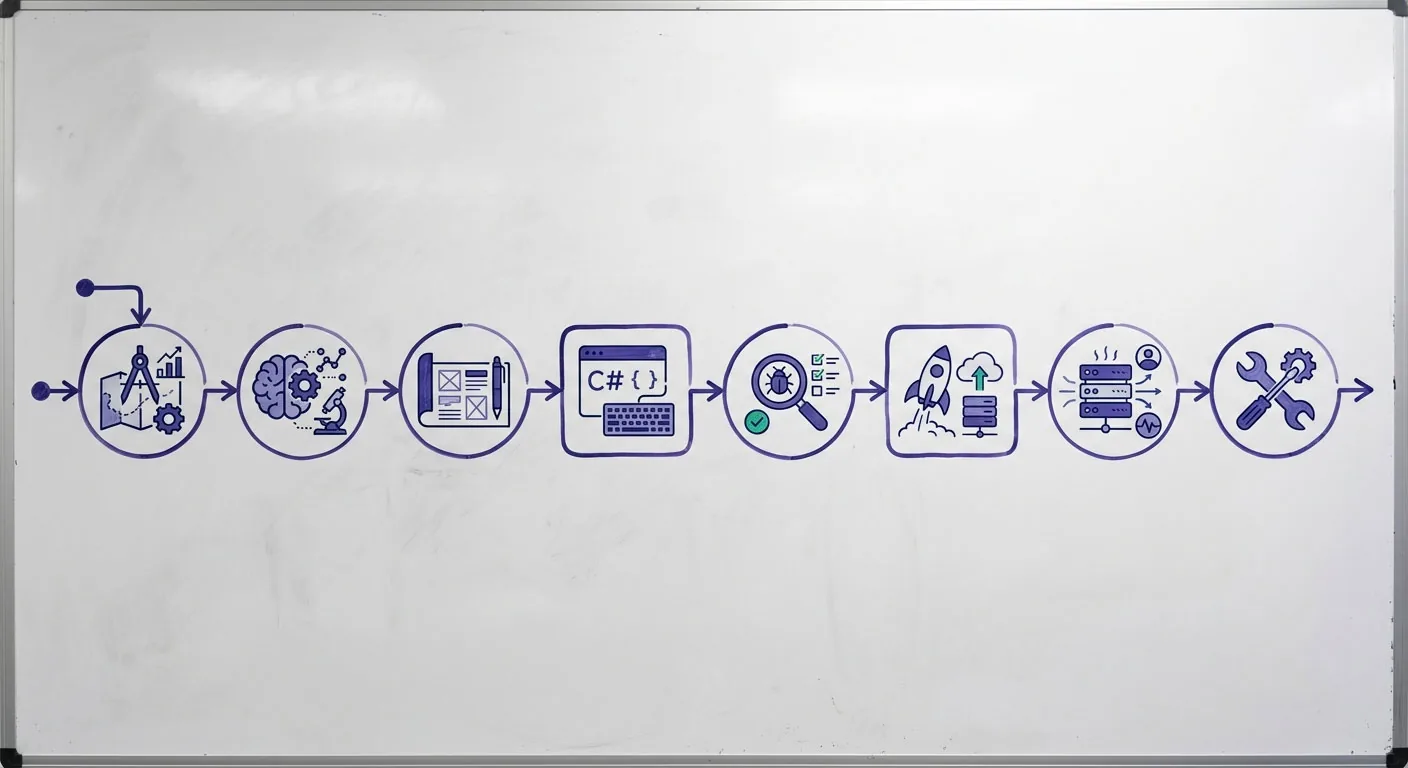
Las 8 fases de desarrollo — semana por semana
This is the actual schedule I use. Not a theoretical framework — the literal week-by-week plan I sent to clients before starting ContaPro, DentalPro, and LegalPro.
| Week | Phase | Deliverables |
|---|---|---|
| Week 1 | Discovery & Architecture | DB schema, API contract, wireframes for 3 core screens, environment setup |
| Week 2 | Auth & Tenant Foundation | User registration, login, JWT, password reset, multi-tenant data isolation |
| Week 3 | Core Feature — Part 1 | The primary workflow your users will do every day — first half |
| Week 4 | Core Feature — Part 2 | Complete the core workflow, add validation, error states, empty states |
| Week 5 | Dashboard & Data Layer | Main dashboard with real data, filters, pagination, basic reporting |
| Week 6 | Billing & Onboarding | Stripe integration, subscription plans, onboarding flow for new users |
| Week 7 | Polish & Edge Cases | Mobile responsiveness, loading states, error handling, performance pass |
| Week 8 | Deploy & Launch | Production deploy, SSL, monitoring (UptimeRobot), onboard first 5 users |
A few things worth noting about this schedule: Week 1 looks light but it's actually the most important week. The decisions you make about your database schema in week 1 will haunt you or reward you for the rest of the project. I typically spend 2-3 days just on the schema before writing a single API route.
Week 7 gets underestimated constantly. "Polish" sounds cosmetic, but this is where you discover that your create form breaks on mobile, that an empty table with no data looks broken, and that your error messages say "Internal Server Error" instead of something helpful. These things matter enormously to early users.
¿Cuánto cuesta construir un SaaS MVP en 2026?
Let's talk numbers. I'll give you the real ranges based on what I charge and what I've seen in the market.
Beyond development, budget for monthly infrastructure: a VPS runs $6–$25/month, a managed PostgreSQL instance on Neon starts at $0 (free tier is generous), Stripe takes 2.9% + $0.30 per transaction, and a transactional email service like Resend costs ~$0–$20/month depending on volume. You can run a real SaaS for under $50/month until you hit meaningful scale.
What should you not spend money on at MVP stage? A fancy UI kit when plain CSS works. A headless CMS when a markdown file will do. Kubernetes, CDNs, read replicas — all of that can wait until you have users who are actually experiencing the problems those solutions solve.
Caso real: cómo construí ContaPro en semanas
ContaPro started with a problem I understood viscerally: Venezuelan businesses deal with a dual-currency accounting system (bolívares and USD) that no off-the-shelf accounting software handles correctly. QuickBooks doesn't know what a "BCV rate" is. Excel spreadsheets break when you have 500 transactions a month.
The first conversation with the client took 45 minutes. I asked three questions: What do you do today that takes too long? What's the one number you need to know every morning? What would you stop doing forever if you could? The answers defined the MVP.
Week 1: I designed a schema with two separate transaction ledgers (one per currency), a daily exchange rate table, and a period-closing mechanism that matches Venezuelan tax reporting requirements. This was the hard part. Everything else was implementation.
Weeks 2–4: Auth, transaction entry form, and the reconciliation engine. The reconciliation logic — matching USD transactions to their bolívar equivalents at the historical rate — was 400 lines of well-tested business logic that became the product's unfair advantage.
Weeks 5–6: Dashboard showing real-time currency-adjusted P&L, balance sheet, and the daily cash position. Stripe billing with a 30-day trial. Onboarding flow that imported from their existing Excel files.
Weeks 7–8: Mobile pass (most users check the dashboard on their phones), polish, production deploy to Oracle Cloud, onboarding of the first 3 paying clients.
The client had paying customers before week 8 ended. Not because we rushed — because we built exactly what they needed and nothing else.
Los 5 errores más comunes al construir un MVP
After building six SaaS products and consulting on dozens more, these are the mistakes I see kill MVPs before they reach users.
- Building features nobody asked for Dark mode, multi-language support, CSV export — all before a single user has tried the product. Validate first. Build second. Always.
- Choosing the wrong database model I've seen SaaS products choose MongoDB for "flexibility" and spend months fighting the lack of schema enforcement. Pick PostgreSQL and define your schema properly from day one.
-
Not thinking about multi-tenancy early enough
Adding a
tenant_idcolumn to 30 tables after launch is a nightmare. If your SaaS will ever serve multiple clients, design for it in week 1. It costs almost nothing to do it early; it costs everything to retrofit it later. - Skipping the onboarding flow You understand your product. Your users don't. If they sign up, see a blank dashboard, and don't know what to do, they'll leave and never come back. An empty state with a clear first action is not optional — it's the product.
- Deploying without monitoring I've had clients go live on a Friday with no uptime monitoring and discover on Monday that the server crashed Saturday morning. Set up UptimeRobot (free), configure PM2 to auto-restart on crash, and make sure someone gets an SMS when the site goes down.
Frequently Asked Questions
Ready to Build Yours?
I've shipped 6 SaaS products across accounting, healthcare, legal, and e-commerce. Tell me what you're building — I'll tell you what it takes and what it costs.
Let's Build Yours →